Our Working CLIL community of practice provides an opportunity for the sharing of Teaching and Learning Materials for CLIL in Portugal. These have been created by content and language teachers working in schools in the country, and are therefore designed to adhere to the Portuguese curriculum. We welcome contributions to this repository from teachers and teacher educators in the country.
In a context such as Portugal where there are few resources available for the study and practice of CLIL, this repository is an invaluable support to students, teachers, teacher educators, and project coordinators.
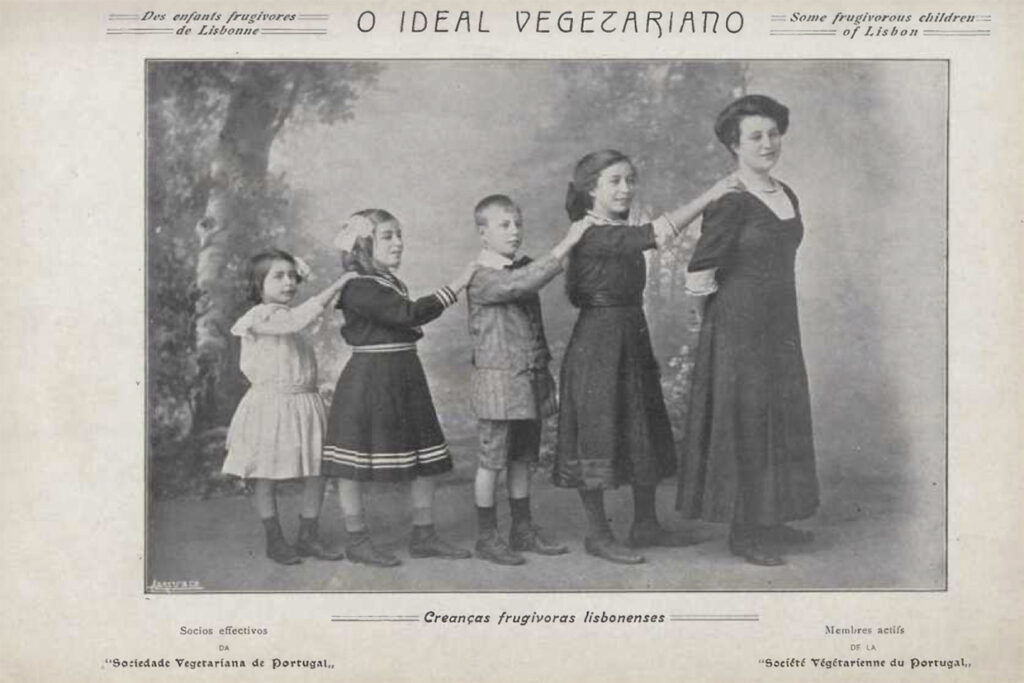
This collection lists the subscribers to the O Vegetariano that we have identified with the help of many contributors.
Do you know of any relatives, friends, or acquaintances who followed a vegetarian diet at the beginning of the 20th century?
We’re expanding our database and need your help gathering information about individuals who followed a vegetarian diet. To learn more about the people we’ve already documented, click here to explore our interactive map which illustrates how these early 20th-century vegetarians were spread across the globe!
The term “blue humanities” was coined in 2009 by the American professor Steve Mentz, it proposed a different direction to humanities focusing on the sea as a key framework for exploring culture, history, human life, and society. In line with this approach, we have created the Blue Humanities database, which gathers a heterogeneous collection of films and books where the sea plays and important role. Currently, the project includes over 70 entries, but our aim is to keep expanding. Therefore, we welcome contributions and recommendations of works that might enrich our repository and contribute to further studies on Blue Humanities field.
Welcome to the "Shakespeare Translation Memory" database, an initiative of CETAPS researchers at Faculdade de Letras da Universidade do Porto. Our aim is to create a repository of ...
The Portuguese Vegetarian Society was founded in 1911. Its monthly periodical, O Vegetariano: Mensário Naturista Ilustrado, directed by Dr. Amílcar De Sousa and published uninterruptedly between 1909 and 1935, had a community of over 3.500 subscribers. All periodical items, besides other related research and outreach outputs, are indexed in this searchable database.
Cross-Cultural Discourses: Portugal, Britain and the Press
The principal aim of the Project is to carry out a critical analysis of the discourses of the twentieth-century Portuguese and British press to assess how far the confrontation of different narratives and portrayal strategies can contribute towards the study of intercultural relations between the two countries as well as assisting in (de)constructing the many cultural images which have played a role in changing and hierarchising the two cultures.
Fiction bridges Science (21) in Anglo-Portguese Contexts
Bridges between Fictional Narratives and Science in the 21st Century (BFS21) is a research project founded in January 2020 developed by CETAPS’s Research Strand Culture, Science and the Media.
An initiative of the CETAPS Digital Lab that offers the academic and non-academic community valuable collections and resources in the fields of English, Translation and Anglo-Portuguese Studies.
O E-Dicionário de Escrita de Viagens Portuguesa (EDEVP) é publicado, sob coordenação de Rogério Miguel Puga, pelo CETAPS (Faculdade de Ciências Sociais e Humanas, Portugal) pelo Institute of Modern Languages Research (Universidade de Londres; Reino Unido) e pelo Laboratório de Interlocuções com a Ásia [LIA; Universidade de São Paulo (USP), Brasil] e é de acesso livre. Os utilizadores deverão consultar os verbetes a partir da lista de entradas. O EDEVP não segue o Novo Acordo Ortográfico, redigindo cada colaborador os seus verbetes na ortografia que adopta.
With over 19,000 entries compiled by Lyman Tower Sargent, this already is the major resource of critical bibliography on utopia, but we expect it to grow with your contribution. Our aim is to have a complete list of critical sources in any language, add digital objects such as abstracts and full texts, and make the database searchable by subject.