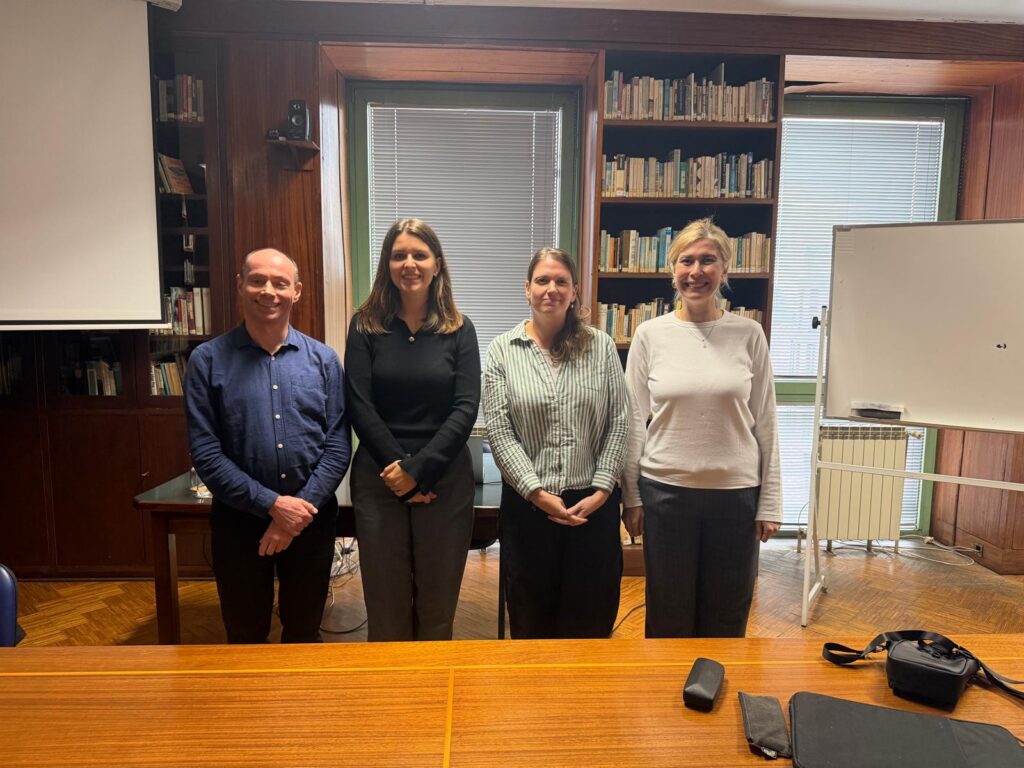
Four international researchers in utopian studies convened at FLUP to discuss “Utopian Critiques of Narratives of Hope and Fear” on 27 October 2026. The seminar was hosted by CETAPS in the Department of Anglo-American Studies. The scholars presented the latest findings of their research, and discussed questions and feedback with an audience of students and guest of honour, Professor Fátima Vieira, coordinator of CETAPS, Porto, and lead of the Mapping Utopianisms Research Area.
Andrea Burgos Mascarell from the University of Valencia discussed how works such as Catherine Leroux’s L’Avenir (The Future) confront ageist stereotypes by envisioning societies in which intergenerational cooperation is an integral part of communal living and solidarity. Andrea draws on ethics of care theories by Carol Gilligan and Maori scholar Krushil Watene, affect theory, and the phenomenological perspective of Emmanuel Levinas to shine a light on “pockets of hope” for better futures in utopian and dystopian narratives.
Iva Dimovska, an MSCA/ERA scholar, discussed her project “Utopias in Times of Crisis: Irish Modernist Literature in the 1920s and 1930s”, which she is currently working on at FLUP/CETAPS. Iva is interested in how literary works register competing visions of the future of Ireland in the context of the establishment of the Irish Free State in 1922. She studies the relationship between national belonging and estrangement, the persistence of colonial structures after independence, and the racialized, patriarchal, and heteronormative boundaries through which national identity was consolidated.
Burcu Kayışcı Akkoyun from Boğaziçi University, İstanbul is investigating how the aesthetic structures of utopian and dystopian texts present human and non-human agency. Burcu considers works such as David Mitchell’s Cloud Atlas and Kazuo Ishiguro’s Klara and the Sun, and their implications for challenging the stasis that attends attempts to achieve economic, sociopolitical, and technological transformations in the twenty-first century.
Liam Benison, from the Institute of Social Sciences at the University of Lisbon, outlined how he intends to create a method to use the historical utopian imagination in the education of sociopolitical desire in the present, drawing on the collective sociopolitical knowledge of past expressions of utopianism. He will draw on canonical utopias such as those of More, Bacon and Campanella as well as lesser known works such as those of feminists such as Moderata Fonte (1555–1592) and the Duchesse de Montpensier (1555–1592), who created visions of societies without marriage, organized by women.